
United States News Nobel Prize in Chemistry Awarded to Architects of Metal-Organic Frameworks
The Royal Swedish Academy of Sciences announced the Nobel Prize in Chemistry
On October 8, 2025, the Royal Swedish Academy of Sciences announced the Nobel Prize in Chemistry, awarding it jointly to three pioneering chemists for their groundbreaking work in developing metal-organic frameworks (MOFs). These laureates—Susumu Kitagawa (Japan), Omar M. Yaghi (United States/Jordan), and Richard Robson (Australia)—are celebrated as the “architects” of MOFs, a revolutionary class of porous materials that have transformed chemical engineering, energy storage, and environmental applications.The LaureatesSusumu Kitagawa (Kyoto University, Japan): A leader in dynamic MOFs, Kitagawa’s research focuses on flexible frameworks that can adapt to guest molecules, enabling applications in gas separation and sensing.
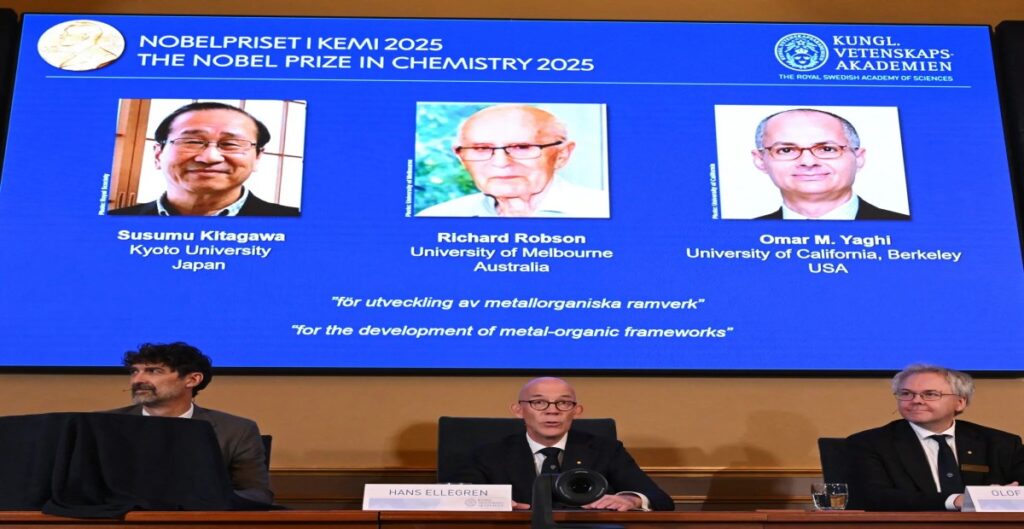
University of California, Berkeley, USA)
Omar M. Yaghi (University of California, Berkeley, USA): Renowned for reticular chemistry—the precise design of crystalline structures—Yaghi has synthesized thousands of MOFs, including those used for carbon capture and water harvesting in arid regions.
Richard Robson (University of Adelaide, Australia): An early pioneer, Robson’s foundational work in the 1990s on coordination polymers laid the groundwork for modern MOFs, emphasizing their crystalline, cage-like structures.
Demonstrated self-assembling coordination networks with permanent porosity.
The trio shares the 11 million Swedish kronor (approximately $1.05 million USD) prize, split equally.What Are Metal-Organic Frameworks?MOFs are hybrid materials composed of metal ions or clusters linked by organic ligands, forming highly ordered, porous crystals with enormous internal surface areas—up to 7,000 square meters per gram, equivalent to a football field in a teaspoon. This porosity allows selective storage, separation, and catalysis of gases and liquids.Unlike traditional porous materials like zeolites, MOFs offer tunable structures, making them “Lego-like” building blocks for custom designs. The Nobel citation highlights how these frameworks create “new rooms for chemistry,” enabling molecules to flow through vast internal spaces.Key Contributions and ImpactThe laureates’ independent yet complementary work spans decades:Robson (late 1980s–1990s): Demonstrated self-assembling coordination networks with permanent porosity.
Applications like hydrogen storage.
Yaghi (1990s–present): Coined the term “MOF” and developed systematic synthesis methods, leading to over 90,000 known structures.
Kitagawa (1990s–present): Explored “breathing” MOFs that expand/contract, enhancing selectivity for applications like hydrogen storage.
Real-World Applications:Energy and Environment: MOFs capture CO₂ from industrial emissions or directly from air, aiding climate mitigation. They also store hydrogen for clean fuel cells.
Water Harvesting: Yaghi’s MOF-303 extracts drinkable water from desert air, producing up to 0.3 liters per kilogram daily in 20% humidity—vital for water-scarce regions.
Medicine and Beyond: Drug delivery, pollutant filtration, and even explosive detection rely on MOFs’ precision.
More details, visit the official Nobel Prize announcement.
This prize underscores chemistry’s role in addressing global challenges, from sustainability to resource scarcity. As the Academy noted, “They have created molecular constructions with large spaces through which gases and other chemicals can flow,” opening doors to sustainable technologies.For more details, visit the official Nobel Prize announcement.